
• 972-499-3593
    Eminent Spine
    • Timeline
    • The Sword of Eminent
    • Products
          • 3D Titanium Pedicle Screw System
          • Scoliosis Deformity
          • Cervical Implants
            • Cervical Stand-Alone
            • Cervical Plate
            • Cervical IBFD
          • SI Systems
            • Lateral SI
            • Posterior SI
          • Lumbar Systems
            • ALIF Stand-Alone (3D Titanium)
            • ALIF (PEEK)
            • Pedicle Screw
            • 3D PLIF & TLIF
            • PLIF
            • TLIF
            • LLIF
            • Buttress Plate
          • Prep Sets
            • SI Prep Sets
            • Cervical Stand-Alone Prep Sets
            • Cervical Plate Prep Sets
            • ALIF Prep Sets
            • PLIF/TLIF Prep Sets
            • Pedicle Screw Prep Sets (Open & MIS)
          • Kyphoplasty
          • Biologics
    • Resources
      • Surgical Technique Manuals
      • White Papers & Usage Reports
      • IFU’s
      • Blog
    • Case Studies
    • Contact
    • Menu Menu

    Titanium vs PEEK in Spinal Implants: Which Is Best for Fusion?

    Material selection plays a critical role in spinal implant performance, particularly when fusion is the primary objective. Among the most commonly used materials today are titanium and polyetheretherketone, better known as PEEK. Each offers distinct mechanical and biological properties that influence stability, bone integration, imaging clarity, and long-term outcomes. As implant technology continues to evolve, understanding the differences between titanium vs PEEK spinal implants is essential for surgeons and healthcare teams evaluating the best option for each case.
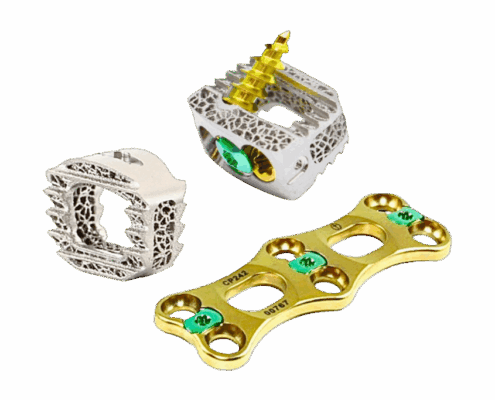
    This article explores how titanium and PEEK compare in spinal fusion applications, including osseointegration, biomechanics, imaging considerations, and clinical use cases.

    Why Implant Material Matters in Spinal Fusion

    Spinal fusion depends on achieving stability while encouraging bone growth across the surgical site. The implant material directly affects how forces are transferred, how bone interacts with the implant surface, and how the body responds biologically over time.

    Key material-related factors influencing fusion include:

    • Modulus of elasticity and load sharing
    • Surface characteristics and bone response
    • Long-term structural stability
    • Compatibility with imaging and follow-up care

    Choosing the right material is less about preference and more about aligning implant properties with anatomy, pathology, and procedural goals.

    Overview of Titanium Spinal Implants

    Titanium has been used in orthopedic and spinal implants for decades. Its strength, corrosion resistance, and biocompatibility make it a trusted material for fixation systems, interbody devices, and pedicle screws.

    Key Properties of Titanium

    • High strength-to-weight ratio
    • Excellent biocompatibility
    • Resistance to corrosion
    • Proven long-term clinical performance

    Traditional titanium implants were solid and relatively stiff, which sometimes created a mismatch between implant and bone. However, advancements in manufacturing, particularly 3D printing, have expanded titanium’s performance capabilities.

    Overview of PEEK Spinal Implants

    PEEK is a radiolucent polymer that gained popularity due to its elastic modulus, which more closely matches cortical bone. This property initially positioned PEEK as an attractive option for interbody fusion devices.

    Key Properties of PEEK

    • Elastic modulus similar to bone
    • Radiolucent for clear postoperative imaging
    • Chemically inert and durable

    Despite these advantages, PEEK is biologically inert, meaning it does not naturally encourage bone growth without additional surface treatments or coatings.

    Titanium vs PEEK Spinal Implants: Fusion and Osseointegration

    One of the most significant differences between titanium and PEEK lies in how each material interacts with bone.

    Titanium and Osseointegration

    Titanium supports natural bone ongrowth and ingrowth. Modern titanium implants, particularly those produced through additive manufacturing, feature porous surfaces that mimic cancellous bone. This structure encourages bone cells to attach, grow, and integrate directly with the implant.

    Benefits include:

    • Improved initial stability
    • Faster fusion progression
    • Strong long-term fixation

    For fusion-focused procedures, titanium’s biological activity provides a meaningful advantage.

    Learn how 3D printed pedicle screw design improves strength, osseointegration, and precision.

    Learn More

    PEEK and Osseointegration Challenges

    PEEK does not inherently promote bone attachment. To compensate, manufacturers often apply surface coatings such as titanium spray or roughened textures. While these treatments improve performance, they do not replicate true bone ingrowth.

    Potential limitations include:

    • Slower fusion timelines
    • Higher reliance on bone graft material
    • Increased risk of fibrous tissue formation

    As a result, PEEK implants may perform differently depending on patient bone quality and surgical technique.

    Biomechanical Performance and Load Sharing

    Titanium Implants

    Titanium’s strength allows it to withstand high mechanical loads, making it suitable for demanding spinal environments. With 3D printing, engineers can now control stiffness by designing internal lattice structures, reducing stress shielding while maintaining durability.

    This balance supports:

    • Better load distribution
    • Reduced risk of subsidence
    • Long-term construct stability

    PEEK Implants

    PEEK’s elastic modulus closely matches bone, which can help reduce stress shielding. However, its lower strength compared to titanium may limit performance in high-load applications or patients with compromised bone.

    In certain cases, this can increase the risk of:

    • Implant micromotion
    • Subsidence
    • Delayed fusion

    Imaging and Postoperative Evaluation

    Imaging With PEEK

    One of PEEK’s primary advantages is radiolucency. Surgeons can clearly visualize bone healing and fusion on X-rays and CT scans without implant interference.

    Imaging With Titanium

    Traditional titanium implants could obscure imaging due to artifact. However, modern titanium designs and imaging protocols have significantly reduced this issue. Additionally, the biological integration of titanium often provides clearer fusion indicators over time.

    Clinical Applications and Case Selection

    Neither material is universally superior. Optimal selection depends on the specific clinical scenario.

    When Titanium May Be Preferred

    • Fusion-focused procedures
    • Patients with poor bone quality
    • High-load spinal regions
    • Cases where osseointegration is critical

    When PEEK May Be Considered

    • Situations prioritizing radiographic visibility
    • Lower-load applications
    • Surgeons seeking bone-like elasticity

    Understanding these distinctions helps guide implant selection based on patient anatomy and procedural goals.

    Cost Considerations and Long-Term Value

    PEEK implants have traditionally been viewed as cost-effective, while titanium implants, especially 3D-printed designs, may carry higher upfront costs. However, evaluating cost requires a long-term perspective.

    Factors influencing overall value include:

    • Fusion success rates
    • Risk of revision surgery
    • Implant longevity
    • Patient recovery timelines

    Improved fusion and reduced complications can offset higher initial implant costs over time.

    Advancements in Titanium Technology

    Recent advancements have addressed many of titanium’s historical limitations. Additive manufacturing allows for:

    • Controlled porosity
    • Bone-mimicking structures
    • Optimized stiffness profiles

    These innovations have strengthened titanium’s position as a leading material for spinal fusion applications.

    Titanium vs PEEK Spinal Implants: Key Takeaways

    • Titanium promotes stronger osseointegration and fusion
    • PEEK offers imaging advantages but limited biological activity
    • 3D-printed titanium reduces stiffness mismatch
    • Material selection should align with anatomy, load, and fusion goals

    The debate is no longer titanium versus PEEK in absolute terms, but rather which material best supports the desired clinical outcome.

    Surface Technology and Its Impact on Fusion

    Beyond base material properties, surface technology plays a significant role in spinal fusion outcomes. Titanium implants benefit from surface roughness and porosity that actively encourage bone attachment. Modern manufacturing methods allow titanium surfaces to be engineered at the micro and macro levels, creating environments that support bone ongrowth and ingrowth. This interaction can lead to stronger implant fixation and more consistent fusion over time.

    PEEK, by contrast, is biologically inert and relies on surface modifications to promote bone response. While coatings and texturing can improve performance, these treatments primarily support bone ongrowth rather than true integration. As a result, fusion success with PEEK implants may depend more heavily on graft material, surgical technique, and patient biology.

    Long-Term Outcomes and Revision Considerations

    Long-term implant performance is a critical factor when comparing titanium and PEEK spinal implants. Titanium’s ability to integrate directly with bone may contribute to lower rates of micromotion and reduced risk of implant loosening over time. This stability can be especially important in multi-level fusions or patients with compromised bone quality.

    PEEK implants, while durable, may present challenges if fusion is delayed or incomplete. In revision scenarios, fibrous tissue formation around PEEK implants can complicate removal or replacement. Understanding how each material behaves over the lifespan of the implant helps surgeons anticipate long-term outcomes and make informed material choices based on both immediate and future considerations.

    Choosing the Right Material for Fusion Success

    Selecting between titanium vs PEEK spinal implants requires balancing biomechanics, biology, and procedural priorities. As fusion outcomes increasingly depend on biological integration and long-term stability, titanium implants, particularly those using advanced manufacturing techniques, continue to gain traction.

    By understanding how each material performs, surgeons and healthcare teams can make informed decisions that support reliable fusion, patient safety, and long-term success across a wide range of spinal procedures.

    Share This Post

    • Share on Facebook
    • Share on X
    • Share on WhatsApp
    • Share on Pinterest
    • Share on LinkedIn
    • Share on Tumblr
    • Share on Vk
    • Share on Reddit
    • Share by Mail

    More Like This

    Cervical Implants Parent Header Image 845x684

    How to Choose a Spinal Implant: A Surgeon’s Guide

    https://www.eminentspine.com/wp-content/uploads/2025/11/Cervical-Implants-Parent-Header-Image-845x684-1.png 684 845 Abstrakt Marketing /wp-content/uploads/2025/08/ES-Logo-Edit-2.png Abstrakt Marketing2026-01-30 03:43:572026-06-01 16:43:31How to Choose a Spinal Implant: A Surgeon’s Guide

    Categories

    • 3d Pedicle Screw Education & Persuasion
    • Lumbar Fusion
    • Miscellaneous
    • SI Joint Solutions
    • Spinal Implant Education
    • Spinal Implant Innovation
    Es Logo Edit

    Products

    3D Titanium Pedicle Screw System

    SI

    Scoliosis Deformity

    Cervical Implants

    Lumbar Systems

    Prep Sets

    Biologics

    Resources

    Surgical Technique Manuals

    Case Studies

    White Papers & Usage Reports

    IFU’s

    1-2 Page Product Information

    Contact

    2004 Ventura Dr. Ste 250
    Plano TX 75093

    972.499.3593

    [email protected]

    Website by Abstrakt Marketing Group ©
      • Sitemap
      • Privacy Policy
      Link to: How to Choose a Spinal Implant: A Surgeon’s Guide Link to: How to Choose a Spinal Implant: A Surgeon’s Guide How to Choose a Spinal Implant: A Surgeon’s GuideCervical Implants Parent Header Image 845x684 Link to: Optimizing Fixation in Lumbar Spinal Fusion: Pedicle Screw Design Considerations Link to: Optimizing Fixation in Lumbar Spinal Fusion: Pedicle Screw Design Considerations Pedicle Screw Header ImageOptimizing Fixation in Lumbar Spinal Fusion: Pedicle Screw Design Consider...
      Scroll to top Scroll to top Scroll to top

      This site uses cookies. By continuing to browse the site, you are agreeing to our use of cookies.

      AcceptLearn more

      Cookie and Privacy Settings


      How we use cookies

      We may request cookies to be set on your device. We use cookies to let us know when you visit our websites, how you interact with us, to enrich your user experience, and to customize your relationship with our website.

      Click on the different category headings to find out more. You can also change some of your preferences. Note that blocking some types of cookies may impact your experience on our websites and the services we are able to offer.

      Essential Website Cookies

      These cookies are strictly necessary to provide you with services available through our website and to use some of its features.

      Because these cookies are strictly necessary to deliver the website, refusing them will have impact how our site functions. You always can block or delete cookies by changing your browser settings and force blocking all cookies on this website. But this will always prompt you to accept/refuse cookies when revisiting our site.

      We fully respect if you want to refuse cookies but to avoid asking you again and again kindly allow us to store a cookie for that. You are free to opt out any time or opt in for other cookies to get a better experience. If you refuse cookies we will remove all set cookies in our domain.

      We provide you with a list of stored cookies on your computer in our domain so you can check what we stored. Due to security reasons we are not able to show or modify cookies from other domains. You can check these in your browser security settings.

      Other external services

      We also use different external services like Google Webfonts, Google Maps, and external Video providers. Since these providers may collect personal data like your IP address we allow you to block them here. Please be aware that this might heavily reduce the functionality and appearance of our site. Changes will take effect once you reload the page.

      Google Webfont Settings:

      Google Map Settings:

      Google reCaptcha Settings:

      Vimeo and Youtube video embeds:

      Accept settingsHide notification only