• 972-499-3593
    Eminent Spine
    • Timeline
    • The Sword of Eminent
    • Products
          • 3D Titanium Pedicle Screw System
          • Scoliosis Deformity
          • Cervical Implants
            • Cervical Stand-Alone
            • Cervical Plate
            • Cervical IBFD
          • SI Systems
            • Lateral SI
            • Posterior SI
          • Lumbar Systems
            • ALIF Stand-Alone (3D Titanium)
            • ALIF (PEEK)
            • Pedicle Screw
            • 3D PLIF & TLIF
            • PLIF
            • TLIF
            • LLIF
            • Buttress Plate
          • Prep Sets
            • SI Prep Sets
            • Cervical Stand-Alone Prep Sets
            • Cervical Plate Prep Sets
            • ALIF Prep Sets
            • PLIF/TLIF Prep Sets
            • Pedicle Screw Prep Sets (Open & MIS)
          • Kyphoplasty
          • Biologics
    • Resources
      • Surgical Technique Manuals
      • White Papers & Usage Reports
      • IFU’s
      • Blog
    • Case Studies
    • Contact
    • Menu Menu

    Cannulated vs. Non-Cannulated Pedicle Screws: A Clinical Design Comparison

    Selecting a pedicle screw configuration involves more than choosing a diameter or a length. Whether a screw is cannulated or non-cannulated shapes how it performs during insertion, how it distributes load, and which surgical approaches it best supports.

    Both designs achieve the same fundamental goal: anchoring a fixation construct within vertebral bone to stabilize a spinal segment during fusion. But the engineering differences between a cannulated pedicle screw and its non-cannulated counterpart are specific and consequential. Understanding where each design excels helps surgeons and procurement teams match instrumentation to technique, anatomy, and case complexity with greater precision.

    Understanding the Structural Difference

    The defining feature separating these two configurations is the internal shaft. That single distinction drives meaningful differences in mechanical behavior and procedural utility.

    What Makes a Pedicle Screw Cannulated

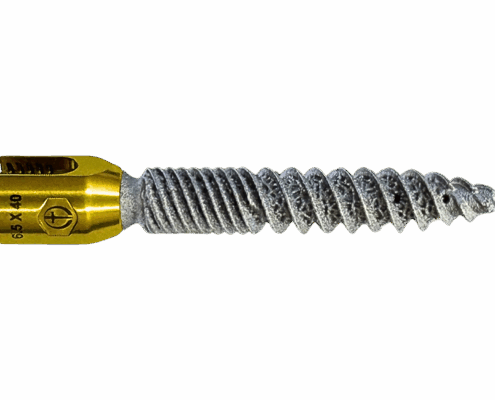
    A cannulated pedicle screw incorporates a hollow channel running through the center of the shaft. This allows a guidewire to pass through during insertion, enabling wire-guided placement within systems such as Eminent Spine’s pedicle screw system. The internal channel is a deliberate design feature intended to improve trajectory accuracy in approaches where direct pedicle visualization is limited. Because the channel reduces the effective cross-sectional area of the shaft, it introduces biomechanical tradeoffs that must be addressed through careful system engineering.

    The Non-Cannulated Configuration

    Non-cannulated screws use a solid core throughout the full shaft length. Without the central channel, the screw retains greater cross-sectional material relative to its outer diameter, improving structural integrity and resistance to cyclic fatigue loading. This configuration has traditionally been the standard in open posterior procedures, where direct pedicle access and visualization reduce reliance on wire-guided insertion.

    Where Cannulated Screws Offer a Clear Advantage

    The strongest clinical case for cannulated designs centers on minimally invasive approaches, where reduced soft tissue exposure limits the ability to rely on anatomic landmarks alone.

    Guided Insertion in MIS Procedures

    In minimally invasive spine surgery, pedicle access is achieved through small incisions with limited direct visualization. Fluoroscopic or navigation-guided K-wire placement establishes the screw trajectory before the implant is advanced. A cannulated pedicle screw slides over the wire and follows that established path with a high degree of reproducibility, reducing the risk of pedicle breach compared to freehand insertion under constrained access. For surgeons building MIS fixation constructs, the cannulated configuration is often a procedural requirement rather than a preference. Eminent Spine’s pedicle screw prep sets for open and MIS procedures are designed to support this full insertion workflow efficiently.

    A Built-In Verification Step

    Wire-guided insertion creates a natural confirmation checkpoint during the procedure. The wire position can be verified radiographically before the implant is seated, allowing the surgeon to correct trajectory before committing the screw. This verification step is difficult to replicate with freehand solid-screw insertion, particularly in cases where posterior anatomy is obscured by limited exposure.

    Structural Tradeoffs of the Cannulated Design

    The hollow channel that enables wire-guided insertion carries real engineering consequences that influence long-term performance. Surgeons evaluating pedicle screw design across instrumentation systems should understand these tradeoffs clearly before committing to a platform.

    Core Diameter and Fatigue Resistance

    Removing material from the shaft center reduces the effective core diameter, which directly affects bending strength and resistance to cyclic fatigue loading. In the lumbar spine, where physiologic forces are substantial and repetitive, fatigue resistance is a critical long-term parameter. A cannulated pedicle screw of equivalent outer diameter to a solid screw carries a smaller structural cross-section, a difference that must be offset through precise material selection, optimized wall thickness, and refined thread geometry. For a deeper look at how thread geometry and core diameter interact in lumbar fixation, pedicle screw design considerations for lumbar fusion offers relevant technical context.

    Practical Implications for Open Procedures

    In open posterior procedures with full pedicle visualization, the added complexity of guidewire management may offer limited benefit while introducing unnecessary procedural steps. The solid-core design simplifies instrumentation workflow and preserves structural properties in settings where direct anatomy guides placement without wire assistance.

    Don’t Let Design Gaps Slow Down Your Case Planning

    The structural difference between a cannulated pedicle screw and a non-cannulated alternative affects fixation performance, fatigue resistance, and surgical workflow in measurable ways. Eminent Spine offers both configurations within a precision-engineered system, giving your team the right tool for every case type.

    Explore Our Pedicle Screw System

    When Non-Cannulated Designs Have the Edge

    Non-cannulated screws remain the preferred choice in clinical scenarios where structural performance takes priority over wire-guided insertion assistance.

    Deformity, Revision, and High-Load Constructs

    In scoliosis correction, lumbar revision procedures, and multi-level fusions, the mechanical demands on fixation hardware increase substantially. Longer constructs and corrective forces place greater stress on individual screw components. The solid core of a non-cannulated design provides enhanced resistance to bending and fatigue loading, making it the stronger choice when load demands are elevated. For complex open procedures where anatomic access is broad and structural performance is the priority, the solid-core configuration consistently aligns with those demands.

    Compatibility With Streamlined Instrumentation

    Non-cannulated screws integrate into open fixation systems without the supplemental K-wire management steps that cannulated insertion requires. This reduces procedural complexity and simplifies the instrumentation tray in environments where workflow efficiency is a priority. The solid-core design supports a straightforward insertion sequence that experienced surgical teams can execute consistently across case types.

    Matching Configuration to Case Requirements

    Neither cannulated nor non-cannulated designs are universally superior. The right choice depends on surgical approach, patient anatomy, bone quality, and construct scope.

    Approach and Anatomic Access

    The surgical approach is often the most decisive factor. MIS procedures with limited pedicle exposure almost always favor cannulated designs, where wire-guided accuracy provides the framework for consistent and reproducible placement. Open posterior cases with broad anatomic access are well served by solid-core screws, which preserve structural properties and simplify the instrumentation sequence.

    Bone Quality and Construct Length

    Patient bone density, pedicle morphology, and the number of levels being fused all influence long-term fixation performance. In osteopenic patients or complex multi-level constructs, maximizing core strength favors the non-cannulated option. For shorter, well-visualized MIS cases with adequate bone stock, the wire-guided accuracy of the cannulated pedicle screw often outweighs the structural tradeoff.

    Engineering Both Options Into a Reliable System

    Understanding the distinction between cannulated and non-cannulated pedicle screw design is part of building a fixation strategy that accounts for case complexity, surgical approach, and long-term biomechanical demands. The structural implications are real and measurable, and the right configuration varies meaningfully by case.

    Eminent Spine offers both cannulated and non-cannulated configurations within its titanium pedicle screw system, backed by precision manufacturing and a comprehensive size range built to accommodate anatomic variability across patient populations. Whether you’re evaluating instrumentation for minimally invasive procedures or demanding open constructs, connect with the Eminent Spine team to explore options engineered to match your clinical workflow.

    Share This Post

    • Share on Facebook
    • Share on X
    • Share on WhatsApp
    • Share on Pinterest
    • Share on LinkedIn
    • Share on Tumblr
    • Share on Vk
    • Share on Reddit
    • Share by Mail

    More Like This

    Pedicle Screw Header Image

    How Triple-Lead Thread Technology Advances Pedicle Screw Performance

    https://www.eminentspine.com/wp-content/uploads/2025/09/Pedicle-Screw-Header-Image.png 1250 2000 Abstrakt Marketing /wp-content/uploads/2025/08/ES-Logo-Edit-2.png Abstrakt Marketing2026-08-04 17:45:202026-08-04 20:23:22How Triple-Lead Thread Technology Advances Pedicle Screw Performance
    3d Screws Heading Image

    How Eminent Spine’s 3D Pedicle Screw Passed FDA 510(k) Clearance

    https://www.eminentspine.com/wp-content/uploads/2025/09/3D-Screws-Heading-Image.png 1250 2000 Abstrakt Marketing /wp-content/uploads/2025/08/ES-Logo-Edit-2.png Abstrakt Marketing2026-07-13 18:27:562026-07-13 18:28:05How Eminent Spine’s 3D Pedicle Screw Passed FDA 510(k) Clearance
    Pedicle Screw Header Image

    What Is a Pedicle Screw and How Is It Used in Spinal Fusion?

    https://www.eminentspine.com/wp-content/uploads/2025/09/Pedicle-Screw-Header-Image.png 1250 2000 Abstrakt Marketing /wp-content/uploads/2025/08/ES-Logo-Edit-2.png Abstrakt Marketing2026-07-13 18:12:062026-07-13 18:12:12What Is a Pedicle Screw and How Is It Used in Spinal Fusion?
    Homepage 3d Pedicle Screw

    When Bone Won’t Hold: The Real Challenges of Pedicle Screw Fixation in Osteoporotic Patients

    https://www.eminentspine.com/wp-content/uploads/2025/08/homepage-3d-Pedicle-Screw.png 799 1545 Abstrakt Marketing /wp-content/uploads/2025/08/ES-Logo-Edit-2.png Abstrakt Marketing2026-06-23 15:28:452026-06-23 15:28:50When Bone Won’t Hold: The Real Challenges of Pedicle Screw Fixation in Osteoporotic Patients
    Pedicle Screw Prep Sets Product Image

    Treatment for Loose Pedicle Screws: Why It Happens and What It Costs

    https://www.eminentspine.com/wp-content/uploads/2025/09/Pedicle-Screw-Prep-Sets-Product-Image.png 1250 2000 Abstrakt Marketing /wp-content/uploads/2025/08/ES-Logo-Edit-2.png Abstrakt Marketing2026-06-23 14:21:112026-06-23 14:22:04Treatment for Loose Pedicle Screws: Why It Happens and What It Costs
    Previous Previous Previous Next Next Next

    Categories

    • 3d Pedicle Screw Education & Persuasion
    • 3D Titanium Pedicle Screw
    • Lumbar Fusion
    • Miscellaneous
    • SI Joint Solutions
    • Spinal Implant Education
    • Spinal Implant Innovation
    Es Logo Edit

    Products

    3D Titanium Pedicle Screw System

    SI

    Scoliosis Deformity

    Cervical Implants

    Lumbar Systems

    Prep Sets

    Biologics

    Resources

    Surgical Technique Manuals

    Case Studies

    White Papers & Usage Reports

    IFU’s

    1-2 Page Product Information

    Contact

    2004 Ventura Dr. Ste 250
    Plano TX 75093

    972.499.3593

    [email protected]

    Website by Abstrakt Marketing Group ©
      • Sitemap
      • Privacy Policy
      Link to: How Triple-Lead Thread Technology Advances Pedicle Screw Performance Link to: How Triple-Lead Thread Technology Advances Pedicle Screw Performance How Triple-Lead Thread Technology Advances Pedicle Screw PerformancePedicle Screw Header Image
      Scroll to top Scroll to top Scroll to top

      This site uses cookies. By continuing to browse the site, you are agreeing to our use of cookies.

      AcceptLearn more

      Cookie and Privacy Settings


      How we use cookies

      We may request cookies to be set on your device. We use cookies to let us know when you visit our websites, how you interact with us, to enrich your user experience, and to customize your relationship with our website.

      Click on the different category headings to find out more. You can also change some of your preferences. Note that blocking some types of cookies may impact your experience on our websites and the services we are able to offer.

      Essential Website Cookies

      These cookies are strictly necessary to provide you with services available through our website and to use some of its features.

      Because these cookies are strictly necessary to deliver the website, refusing them will have impact how our site functions. You always can block or delete cookies by changing your browser settings and force blocking all cookies on this website. But this will always prompt you to accept/refuse cookies when revisiting our site.

      We fully respect if you want to refuse cookies but to avoid asking you again and again kindly allow us to store a cookie for that. You are free to opt out any time or opt in for other cookies to get a better experience. If you refuse cookies we will remove all set cookies in our domain.

      We provide you with a list of stored cookies on your computer in our domain so you can check what we stored. Due to security reasons we are not able to show or modify cookies from other domains. You can check these in your browser security settings.

      Other external services

      We also use different external services like Google Webfonts, Google Maps, and external Video providers. Since these providers may collect personal data like your IP address we allow you to block them here. Please be aware that this might heavily reduce the functionality and appearance of our site. Changes will take effect once you reload the page.

      Google Webfont Settings:

      Google Map Settings:

      Google reCaptcha Settings:

      Vimeo and Youtube video embeds:

      Accept settingsHide notification only