• 972-499-3593
    Eminent Spine
    • Timeline
    • The Sword of Eminent
    • Products
          • 3D Titanium Pedicle Screw System
          • Scoliosis Deformity
          • Cervical Implants
            • Cervical Stand-Alone
            • Cervical Plate
            • Cervical IBFD
          • SI Systems
            • Lateral SI
            • Posterior SI
          • Lumbar Systems
            • ALIF Stand-Alone (3D Titanium)
            • ALIF (PEEK)
            • Pedicle Screw
            • 3D PLIF & TLIF
            • PLIF
            • TLIF
            • LLIF
            • Buttress Plate
          • Prep Sets
            • SI Prep Sets
            • Cervical Stand-Alone Prep Sets
            • Cervical Plate Prep Sets
            • ALIF Prep Sets
            • PLIF/TLIF Prep Sets
            • Pedicle Screw Prep Sets (Open & MIS)
          • Kyphoplasty
          • Biologics
    • Resources
      • Surgical Technique Manuals
      • White Papers & Usage Reports
      • IFU’s
      • Blog
    • Case Studies
    • Contact
    • Menu Menu

    Pedicle Screw Fixation in Long Construct Scoliosis

    Long construct scoliosis surgery places every component of a fixation system under forces that short-segment procedures don’t replicate. When a construct spans ten or more vertebral levels and terminates at the pelvis, the mechanical demands at each anchor point compound with every degree of residual imbalance and every postoperative load cycle. What those forces expose in an underperforming implant shapes every hardware decision from screw diameter to pelvic fixation strategy.
    Why Long Constructs Fail Differently

    Standard pedicle screw fixation cases and long construct scoliosis corrections aren’t just different in length. They’re biomechanically different in kind, and the failure modes that emerge in deformity surgery reflect that distinction.

    The Lever Arm Problem

    In short fusions, stress distributes across a manageable arc. In a construct spanning the thoracic spine to the sacrum, that arc becomes a lever. The screws at the lumbosacral junction and pelvic anchors bear substantially higher loads than those at proximal levels, and the anchors flanking the deformity apex carry additional forces generated by corrective rod contouring. Toggling or micromotion at these critical points initiates a cycle that can advance to loosening, pseudoarthrosis, and hardware failure.

    Risk Factors That Compound the Challenge

    Several variables consistently increase fixation failure risk in long construct scoliosis. Fusion to the sacrum, postoperative thoracolumbar kyphosis exceeding 10 degrees, sagittal imbalance, and lateral subluxation each place elevated cyclic load on the construct over time. Bone quality is equally consequential: osteopenia and osteoporosis reduce pullout resistance at the screw-bone interface, and adult deformity patients increasingly present with age-related bone loss that must factor into how fixation is planned and selected.

    There’s no universal level-count cutoff, but surgeons generally apply long construct protocols to fusions spanning five or more lumbar levels, cases extending to the pelvis, or adult deformity with a primary Cobb angle exceeding 40 degrees. The practical implication isn’t the count itself: it’s the correction torque stored in the rod, the leverage at end-level anchors, and the aggregate mechanical demand on the system across the patient’s lifetime.

    Screw Density and Size Range

    Higher screw density distributes fixation forces more evenly and reduces load concentration at any single anchor. In scoliosis instrumentation, pedicle diameter varies substantially from thoracic to lumbar levels across the deformity curve, which means the implant system needs to accommodate a wide diameter range without compromising purchase. Polyaxial cannulated screws spanning 6.0mm to 12.5mm in diameter and 40mm to 110mm in length address the range of pedicle anatomy actually encountered in these cases, rather than the anatomy of simpler procedures.

    Pelvic Fixation

    When a construct extends to the sacrum, iliac fixation becomes standard rather than supplemental. Iliac bolts anchor into dense iliac bone and reduce the stress placed on S1 and S2 screws, which otherwise bear the majority of the construct’s load at the lumbosacral junction. The fixation system must integrate iliac bolt options cleanly with the rod and connector components, without requiring adaptor solutions that introduce additional failure points.

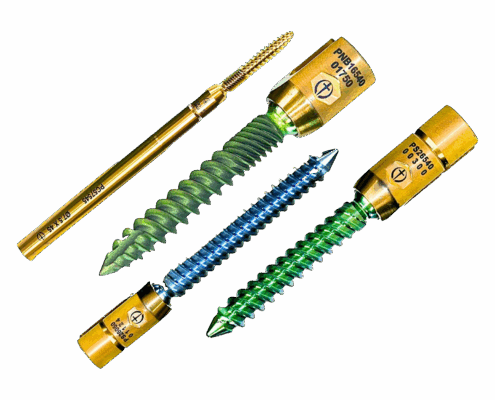
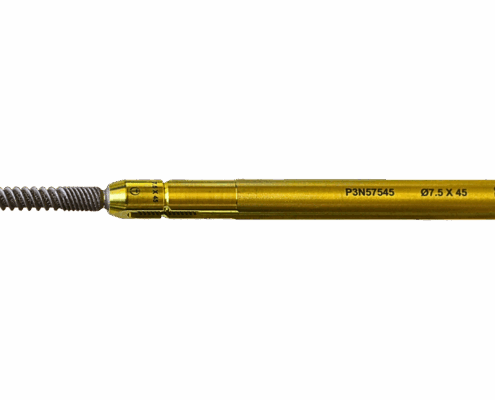
    Fixation hardware built for short-segment lumbar procedures wasn’t designed for the lever arm mechanics of a deformity construct. Eminent Spine’s Scoliosis Deformity Pedicle Screw System was engineered for these demands, with the complete component set a long construct requires.

    Explore the System

    Polyaxial Design in Deformity Correction

    Pedicle trajectories in a scoliotic spine rarely run parallel, and rods contoured for coronal and sagittal correction create complex multiplanar forces at each screw head. That’s why polyaxial screw design is particularly important in long construct scoliosis cases, and why the accommodation range of the head matters as much as the shank dimensions.

    How Polyaxial Heads Reduce Stress Concentration

    A polyaxial head allows the surgeon to achieve secure rod seating even when screw trajectories diverge from the rod’s path. This reduces the off-axis load placed on each interface during rod insertion and long-term loading. A screw fighting its own geometry becomes a stress concentration. A screw that seats cleanly distributes load through the shank and into bone where it belongs.

    Rod Diameter and Contour Options

    Rods for long construct scoliosis typically run 5.5mm in diameter, where stiffness supports correction without an excessive profile. Pre-contoured rod options reduce intraoperative bending time and allow for more reproducible sagittal profiles at the lumbar lordosis and thoracolumbar junction, where contour consistency directly affects postoperative balance. Straight rod options remain essential for cases where the surgeon requires full intraoperative control over the final shape. Having both available in a range from 40mm to 600mm means the rod selection matches the case, not the other way around.

    Fusion Biology in Challenging Bone

    Adult deformity patients are more likely to present with osteopenia or osteoporosis than the typical lumbar fusion candidate, and revision cases introduce disrupted bony architecture that adds to the biological challenge. In these scenarios, the implant surface’s interaction with host bone directly influences long-term construct stability.

    The Case for 3D-Printed Titanium

    The 3D-printed titanium surface architecture used in Eminent Spine’s pedicle screw platform creates a porous structure that promotes bone ingrowth at the implant interface rather than relying solely on mechanical press-fit. This osteoblastic environment accelerates osseointegration, which matters most in osteoporotic bone where initial mechanical purchase may be acceptable but long-term biological integration determines whether the construct remains stable at one year and beyond. The biological advantage that 3D titanium surface technology holds over machined implant designs becomes more pronounced as patient bone quality decreases, not less.

    Cross connectors add torsional rigidity across the construct, an important factor in long-segment cases where rotational forces from deformity correction are ongoing. Planning the right implant configuration across every level requires the same individualized approach that patient-specific fixation planning demands in any complex spinal case.

    Selecting Hardware Built for These Cases

    Pedicle screw fixation in long construct scoliosis requires a complete system, not components sourced for simpler indications. Eminent Spine’s Scoliosis Deformity Pedicle Screw System, FDA 510(k) cleared in August 2024, was built around the mechanical and biological demands that define these cases: polyaxial cannulated screws across a full diameter and length range, 5.5mm rods in straight and pre-contoured options from 40mm to 600mm, cross connectors in three length configurations, rod connectors, and iliac bolt options in an integrated construct. If you’re evaluating fixation systems for adult deformity and long construct scoliosis cases, reach out to the Eminent Spine team to discuss what this system supports.

    Share This Post

    • Share on Facebook
    • Share on X
    • Share on WhatsApp
    • Share on Pinterest
    • Share on LinkedIn
    • Share on Tumblr
    • Share on Vk
    • Share on Reddit
    • Share by Mail

    More Like This

    Pedicle Screw Header Image

    MIS Pedicle Screw vs. Open Screw Placement: What Drives the Decision?

    https://www.eminentspine.com/wp-content/uploads/2025/09/Pedicle-Screw-Header-Image.png 1250 2000 Abstrakt Marketing /wp-content/uploads/2025/08/ES-Logo-Edit-2.png Abstrakt Marketing2026-09-14 19:16:402026-09-14 19:18:14MIS Pedicle Screw vs. Open Screw Placement: What Drives the Decision?
    Non Cannulated Image

    Cannulated vs. Non-Cannulated Pedicle Screws: A Clinical Design Comparison

    https://www.eminentspine.com/wp-content/uploads/2025/10/Non-Cannulated-image.png 1250 2000 Abstrakt Marketing /wp-content/uploads/2025/08/ES-Logo-Edit-2.png Abstrakt Marketing2026-08-04 20:17:212026-08-04 20:21:00Cannulated vs. Non-Cannulated Pedicle Screws: A Clinical Design Comparison
    Homepage 3d Pedicle Screw

    How Triple-Lead Thread Technology Advances Pedicle Screw Performance

    https://www.eminentspine.com/wp-content/uploads/2025/08/homepage-3d-Pedicle-Screw.png 799 1545 Abstrakt Marketing /wp-content/uploads/2025/08/ES-Logo-Edit-2.png Abstrakt Marketing2026-08-04 17:45:202026-08-04 20:24:14How Triple-Lead Thread Technology Advances Pedicle Screw Performance
    3d Screws Heading Image

    How Eminent Spine’s 3D Pedicle Screw Passed FDA 510(k) Clearance

    https://www.eminentspine.com/wp-content/uploads/2025/09/3D-Screws-Heading-Image.png 1250 2000 Abstrakt Marketing /wp-content/uploads/2025/08/ES-Logo-Edit-2.png Abstrakt Marketing2026-07-13 18:27:562026-07-13 18:28:05How Eminent Spine’s 3D Pedicle Screw Passed FDA 510(k) Clearance
    Pedicle Screw Header Image

    What Is a Pedicle Screw and How Is It Used in Spinal Fusion?

    https://www.eminentspine.com/wp-content/uploads/2025/09/Pedicle-Screw-Header-Image.png 1250 2000 Abstrakt Marketing /wp-content/uploads/2025/08/ES-Logo-Edit-2.png Abstrakt Marketing2026-07-13 18:12:062026-07-13 18:12:12What Is a Pedicle Screw and How Is It Used in Spinal Fusion?
    Homepage 3d Pedicle Screw

    When Bone Won’t Hold: The Real Challenges of Pedicle Screw Fixation in Osteoporotic Patients

    https://www.eminentspine.com/wp-content/uploads/2025/08/homepage-3d-Pedicle-Screw.png 799 1545 Abstrakt Marketing /wp-content/uploads/2025/08/ES-Logo-Edit-2.png Abstrakt Marketing2026-06-23 15:28:452026-06-23 15:28:50When Bone Won’t Hold: The Real Challenges of Pedicle Screw Fixation in Osteoporotic Patients
    Pedicle Screw Prep Sets Product Image

    Treatment for Loose Pedicle Screws: Why It Happens and What It Costs

    https://www.eminentspine.com/wp-content/uploads/2025/09/Pedicle-Screw-Prep-Sets-Product-Image.png 1250 2000 Abstrakt Marketing /wp-content/uploads/2025/08/ES-Logo-Edit-2.png Abstrakt Marketing2026-06-23 14:21:112026-06-23 14:22:04Treatment for Loose Pedicle Screws: Why It Happens and What It Costs
    Previous Previous Previous Next Next Next

    Categories

    • 3d Pedicle Screw Education & Persuasion
    • 3D Titanium Pedicle Screw
    • Lumbar Fusion
    • Miscellaneous
    • SI Joint Solutions
    • Spinal Implant Education
    • Spinal Implant Innovation
    Es Logo Edit

    Products

    3D Titanium Pedicle Screw System

    SI

    Scoliosis Deformity

    Cervical Implants

    Lumbar Systems

    Prep Sets

    Biologics

    Resources

    Surgical Technique Manuals

    Case Studies

    White Papers & Usage Reports

    IFU’s

    1-2 Page Product Information

    Contact

    2004 Ventura Dr. Ste 250
    Plano TX 75093

    972.499.3593

    [email protected]

    Website by Abstrakt Marketing Group ©
      • Sitemap
      • Privacy Policy
      Link to: MIS Pedicle Screw vs. Open Screw Placement: What Drives the Decision? Link to: MIS Pedicle Screw vs. Open Screw Placement: What Drives the Decision? MIS Pedicle Screw vs. Open Screw Placement: What Drives the Decision?Pedicle Screw Header Image
      Scroll to top Scroll to top Scroll to top

      This site uses cookies. By continuing to browse the site, you are agreeing to our use of cookies.

      AcceptLearn more

      Cookie and Privacy Settings


      How we use cookies

      We may request cookies to be set on your device. We use cookies to let us know when you visit our websites, how you interact with us, to enrich your user experience, and to customize your relationship with our website.

      Click on the different category headings to find out more. You can also change some of your preferences. Note that blocking some types of cookies may impact your experience on our websites and the services we are able to offer.

      Essential Website Cookies

      These cookies are strictly necessary to provide you with services available through our website and to use some of its features.

      Because these cookies are strictly necessary to deliver the website, refusing them will have impact how our site functions. You always can block or delete cookies by changing your browser settings and force blocking all cookies on this website. But this will always prompt you to accept/refuse cookies when revisiting our site.

      We fully respect if you want to refuse cookies but to avoid asking you again and again kindly allow us to store a cookie for that. You are free to opt out any time or opt in for other cookies to get a better experience. If you refuse cookies we will remove all set cookies in our domain.

      We provide you with a list of stored cookies on your computer in our domain so you can check what we stored. Due to security reasons we are not able to show or modify cookies from other domains. You can check these in your browser security settings.

      Other external services

      We also use different external services like Google Webfonts, Google Maps, and external Video providers. Since these providers may collect personal data like your IP address we allow you to block them here. Please be aware that this might heavily reduce the functionality and appearance of our site. Changes will take effect once you reload the page.

      Google Webfont Settings:

      Google Map Settings:

      Google reCaptcha Settings:

      Vimeo and Youtube video embeds:

      Accept settingsHide notification only