• 972-499-3593
    Eminent Spine
    • Timeline
    • The Sword of Eminent
    • Products
          • 3D Titanium Pedicle Screw System
          • Scoliosis Deformity
          • Cervical Implants
            • Cervical Stand-Alone
            • Cervical Plate
            • Cervical IBFD
          • SI Systems
            • Lateral SI
            • Posterior SI
          • Lumbar Systems
            • ALIF Stand-Alone (3D Titanium)
            • ALIF (PEEK)
            • Pedicle Screw
            • 3D PLIF & TLIF
            • PLIF
            • TLIF
            • LLIF
            • Buttress Plate
          • Prep Sets
            • SI Prep Sets
            • Cervical Stand-Alone Prep Sets
            • Cervical Plate Prep Sets
            • ALIF Prep Sets
            • PLIF/TLIF Prep Sets
            • Pedicle Screw Prep Sets (Open & MIS)
          • Kyphoplasty
          • Biologics
    • Resources
      • Surgical Technique Manuals
      • White Papers & Usage Reports
      • IFU’s
      • Blog
    • Case Studies
    • Contact
    • Menu Menu

    MIS Pedicle Screw vs. Open Screw Placement: What Drives the Decision?

    Both MIS and open pedicle screw placement achieve posterior spinal fixation, but the demands they place on the surgeon, the imaging team, and the implant are fundamentally different. Selecting between them isn’t a stylistic preference—it follows from patient anatomy, bone quality, surgical history, and the specific construct goals of the procedure. The fixation system you’re working with has to be engineered to perform under either set of conditions.
    What Separates MIS and Open Pedicle Screw Techniques

    The distinction between approaches comes down to how the surgeon gains access to the pedicle entry point and how screw position is confirmed intraoperatively.

    Open Technique

    In open pedicle screw fixation, the surgeon exposes the spine through a midline incision and retracts the paraspinal musculature to achieve direct visualization of the posterior bony anatomy. Anatomical landmarks, the transverse process, facet joint, and pedicle isthmus, are identified and palpated directly. The surgeon can confirm pedicle wall integrity with a probe and place the screw under direct tactile and visual feedback. Open technique carries more intraoperative blood loss and longer recovery from muscle retraction, but it gives the surgeon information that no imaging system fully replicates.

    MIS Technique

    In minimally invasive spine surgery, the surgeon accesses the spine percutaneously through small stab incisions, with sequential dilation rather than open retraction. Direct visualization is limited. Screw trajectory is established and confirmed through fluoroscopy or intraoperative navigation, so placement accuracy depends heavily on image quality and guidance system precision. Published accuracy rates for MIS pedicle screw placement with fluoroscopy range widely based on surgeon experience and patient imaging complexity, which is why technique and implant selection both matter in percutaneous approaches. Critically, the screw must be delivered over a guidewire — which requires a cannulated design to allow wire passage through the implant during insertion.

    Implant Requirements Change With the Approach

    The differences in access and visualization create specific engineering requirements that a pedicle screw insertion technique has to account for before it can reliably support both MIS and open procedures.

    Cannulation and Guidewire Compatibility

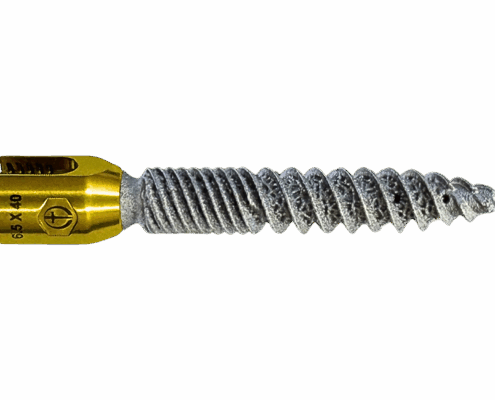
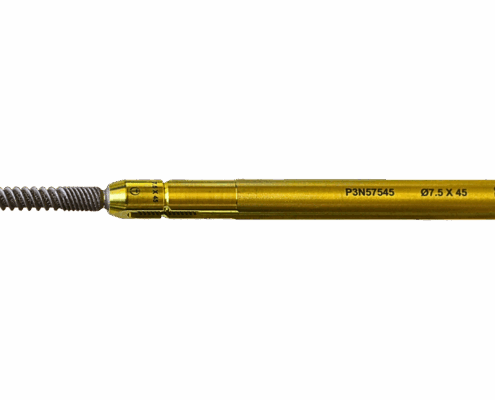
    MIS pedicle screw placement is not technically possible with a solid, non-cannulated screw. The guidewire-over-trocar sequence requires the screw to accept a Kirschner wire through its full length so the surgeon can track the established trajectory during delivery. Any system that doesn’t offer a cannulated option forces the surgeon to either change technique or change implant systems mid-procedure. Eminent Spine’s 3D Titanium Pedicle Screw System is available in both cannulated and non-cannulated profiles specifically to address this requirement the cannulated version accepts a guidewire for percutaneous placement while the non-cannulated version maintains a solid shank for open cases.

    Head Design and Rod Capture

    MIS technique also changes what the screw head needs to do. In open surgery, the surgeon directly visualizes rod reduction and set cap seating. In MIS, those steps happen through a tube retractor with limited line of sight. Tulip head geometry that accepts the rod across a wider capture angle reduces the difficulty of blind rod capture and lowers the risk of cross-threading the set cap during closure. The instrumentation required for open and MIS pedicle screw procedures includes approach-specific tools that simplify case setup when the approach is confirmed preoperatively.

    Approach determines what the implant needs to deliver. A fixation system engineered across both MIS and open technique gives your OR full flexibility without compromising construct performance under either method.

    Reach Out

    Patient Factors That Guide Approach Selection

    Neither approach is universally superior. The choice follows from the clinical picture in front of you.

    Anatomy, Imaging Quality, and Body Habitus

    Fluoroscopy-dependent MIS placement becomes less reliable when imaging is compromised in patients with significant obesity, poor bone density, or transitional vertebral anatomy. Open technique provides tactile feedback that fluoroscopy can’t replicate, and that tactile confirmation matters when image quality is degraded or landmark identification is ambiguous. The learning curve for MIS is also steeper; surgeons early in their percutaneous experience should weigh the accuracy implications before transitioning to MIS for anatomically complex cases.

    Prior Surgery and Scar Tissue

    Patients with previous posterior spinal surgery present epidural and paraspinal scarring that can make MIS dilation dangerous and anatomically unpredictable. Open technique allows the surgeon to identify and manage scar tissue directly before placing any instrumentation. The broader question of how approach selection fits within lumbar fusion construct planning, including implant type, screw sizing, and fixation strategy across bone quality, is a distinct clinical decision covered in pedicle screw design considerations for lumbar spinal fusion.

    What Both Approaches Demand From the Fixation System

    Regardless of approach, pedicle screws face the same biomechanical environment once they’re inside the bone. The intraoperative access path doesn’t change what the screw has to tolerate in vivo.

    Pullout Resistance and Bone-Implant Integration

    Screw pullout is the critical failure mode in both MIS and open constructs. The primary driver of pullout resistance isn’t surgical precision alone—it’s the quality of the bone-implant interface over time. Thread geometry, surface architecture, and material properties all contribute to how well the screw holds under cyclic loading. The role that 3D pedicle screw surface technology plays in driving osseointegration at the thread level explains why long-term fixation is a function of implant engineering as much as placement accuracy.

    Consistency Across Variable Bone Quality

    Both MIS and open procedures encounter variability in bone density across patients and across levels within the same patient. A system that performs predictably across normal and osteoporotic bone gives the surgeon consistent fixation regardless of what the bone offers at each level. When the implant accounts for bone quality variability through surface and thread design, approach selection can stay focused on access and anatomy rather than fixation risk.

    One System for Both Scenarios

    The choice between MIS and open pedicle screw placement is a clinical decision that belongs to the surgeon and the case, not to the implant catalog. What shouldn’t complicate that decision is whether the fixation system can actually perform under both conditions. Eminent Spine’s pedicle screw portfolio covers both approaches with cannulated and non-cannulated options, tulip head geometry designed for percutaneous rod capture, and a 3D printed titanium surface that drives osseointegration independent of how the screw was placed. If you’re evaluating fixation systems that give your program full range across MIS and open technique, reach out to the Eminent Spine team to discuss what that looks like in your cases.

    Share This Post

    • Share on Facebook
    • Share on X
    • Share on WhatsApp
    • Share on Pinterest
    • Share on LinkedIn
    • Share on Tumblr
    • Share on Vk
    • Share on Reddit
    • Share by Mail

    More Like This

    Revised Screw

    Pedicle Screw Fixation in Long Construct Scoliosis

    https://www.eminentspine.com/wp-content/uploads/2025/10/Revised-screw.png 1250 2000 Abstrakt Marketing /wp-content/uploads/2025/08/ES-Logo-Edit-2.png Abstrakt Marketing2026-09-14 19:22:132026-09-14 19:26:20Pedicle Screw Fixation in Long Construct Scoliosis
    Non Cannulated Image

    Cannulated vs. Non-Cannulated Pedicle Screws: A Clinical Design Comparison

    https://www.eminentspine.com/wp-content/uploads/2025/10/Non-Cannulated-image.png 1250 2000 Abstrakt Marketing /wp-content/uploads/2025/08/ES-Logo-Edit-2.png Abstrakt Marketing2026-08-04 20:17:212026-08-04 20:21:00Cannulated vs. Non-Cannulated Pedicle Screws: A Clinical Design Comparison
    Homepage 3d Pedicle Screw

    How Triple-Lead Thread Technology Advances Pedicle Screw Performance

    https://www.eminentspine.com/wp-content/uploads/2025/08/homepage-3d-Pedicle-Screw.png 799 1545 Abstrakt Marketing /wp-content/uploads/2025/08/ES-Logo-Edit-2.png Abstrakt Marketing2026-08-04 17:45:202026-08-04 20:24:14How Triple-Lead Thread Technology Advances Pedicle Screw Performance
    3d Screws Heading Image

    How Eminent Spine’s 3D Pedicle Screw Passed FDA 510(k) Clearance

    https://www.eminentspine.com/wp-content/uploads/2025/09/3D-Screws-Heading-Image.png 1250 2000 Abstrakt Marketing /wp-content/uploads/2025/08/ES-Logo-Edit-2.png Abstrakt Marketing2026-07-13 18:27:562026-07-13 18:28:05How Eminent Spine’s 3D Pedicle Screw Passed FDA 510(k) Clearance
    Pedicle Screw Header Image

    What Is a Pedicle Screw and How Is It Used in Spinal Fusion?

    https://www.eminentspine.com/wp-content/uploads/2025/09/Pedicle-Screw-Header-Image.png 1250 2000 Abstrakt Marketing /wp-content/uploads/2025/08/ES-Logo-Edit-2.png Abstrakt Marketing2026-07-13 18:12:062026-07-13 18:12:12What Is a Pedicle Screw and How Is It Used in Spinal Fusion?
    Homepage 3d Pedicle Screw

    When Bone Won’t Hold: The Real Challenges of Pedicle Screw Fixation in Osteoporotic Patients

    https://www.eminentspine.com/wp-content/uploads/2025/08/homepage-3d-Pedicle-Screw.png 799 1545 Abstrakt Marketing /wp-content/uploads/2025/08/ES-Logo-Edit-2.png Abstrakt Marketing2026-06-23 15:28:452026-06-23 15:28:50When Bone Won’t Hold: The Real Challenges of Pedicle Screw Fixation in Osteoporotic Patients
    Pedicle Screw Prep Sets Product Image

    Treatment for Loose Pedicle Screws: Why It Happens and What It Costs

    https://www.eminentspine.com/wp-content/uploads/2025/09/Pedicle-Screw-Prep-Sets-Product-Image.png 1250 2000 Abstrakt Marketing /wp-content/uploads/2025/08/ES-Logo-Edit-2.png Abstrakt Marketing2026-06-23 14:21:112026-06-23 14:22:04Treatment for Loose Pedicle Screws: Why It Happens and What It Costs
    Pedicle Screw Header Image

    Surface Technology in 3D Pedicle Screws: Advancing Osseointegration

    https://www.eminentspine.com/wp-content/uploads/2025/09/Pedicle-Screw-Header-Image.png 1250 2000 Abstrakt Marketing /wp-content/uploads/2025/08/ES-Logo-Edit-2.png Abstrakt Marketing2026-04-15 20:07:212026-07-13 18:12:32Surface Technology in 3D Pedicle Screws: Advancing Osseointegration
    Previous Previous Previous Next Next Next

    Categories

    • 3d Pedicle Screw Education & Persuasion
    • 3D Titanium Pedicle Screw
    • Lumbar Fusion
    • Miscellaneous
    • SI Joint Solutions
    • Spinal Implant Education
    • Spinal Implant Innovation
    Es Logo Edit

    Products

    3D Titanium Pedicle Screw System

    SI

    Scoliosis Deformity

    Cervical Implants

    Lumbar Systems

    Prep Sets

    Biologics

    Resources

    Surgical Technique Manuals

    Case Studies

    White Papers & Usage Reports

    IFU’s

    1-2 Page Product Information

    Contact

    2004 Ventura Dr. Ste 250
    Plano TX 75093

    972.499.3593

    [email protected]

    Website by Abstrakt Marketing Group ©
      • Sitemap
      • Privacy Policy
      Link to: Cannulated vs. Non-Cannulated Pedicle Screws: A Clinical Design Comparison Link to: Cannulated vs. Non-Cannulated Pedicle Screws: A Clinical Design Comparison Cannulated vs. Non-Cannulated Pedicle Screws: A Clinical Design ComparisonNon Cannulated Image Link to: Pedicle Screw Fixation in Long Construct Scoliosis Link to: Pedicle Screw Fixation in Long Construct Scoliosis Revised ScrewPedicle Screw Fixation in Long Construct Scoliosis
      Scroll to top Scroll to top Scroll to top

      This site uses cookies. By continuing to browse the site, you are agreeing to our use of cookies.

      AcceptLearn more

      Cookie and Privacy Settings


      How we use cookies

      We may request cookies to be set on your device. We use cookies to let us know when you visit our websites, how you interact with us, to enrich your user experience, and to customize your relationship with our website.

      Click on the different category headings to find out more. You can also change some of your preferences. Note that blocking some types of cookies may impact your experience on our websites and the services we are able to offer.

      Essential Website Cookies

      These cookies are strictly necessary to provide you with services available through our website and to use some of its features.

      Because these cookies are strictly necessary to deliver the website, refusing them will have impact how our site functions. You always can block or delete cookies by changing your browser settings and force blocking all cookies on this website. But this will always prompt you to accept/refuse cookies when revisiting our site.

      We fully respect if you want to refuse cookies but to avoid asking you again and again kindly allow us to store a cookie for that. You are free to opt out any time or opt in for other cookies to get a better experience. If you refuse cookies we will remove all set cookies in our domain.

      We provide you with a list of stored cookies on your computer in our domain so you can check what we stored. Due to security reasons we are not able to show or modify cookies from other domains. You can check these in your browser security settings.

      Other external services

      We also use different external services like Google Webfonts, Google Maps, and external Video providers. Since these providers may collect personal data like your IP address we allow you to block them here. Please be aware that this might heavily reduce the functionality and appearance of our site. Changes will take effect once you reload the page.

      Google Webfont Settings:

      Google Map Settings:

      Google reCaptcha Settings:

      Vimeo and Youtube video embeds:

      Accept settingsHide notification only